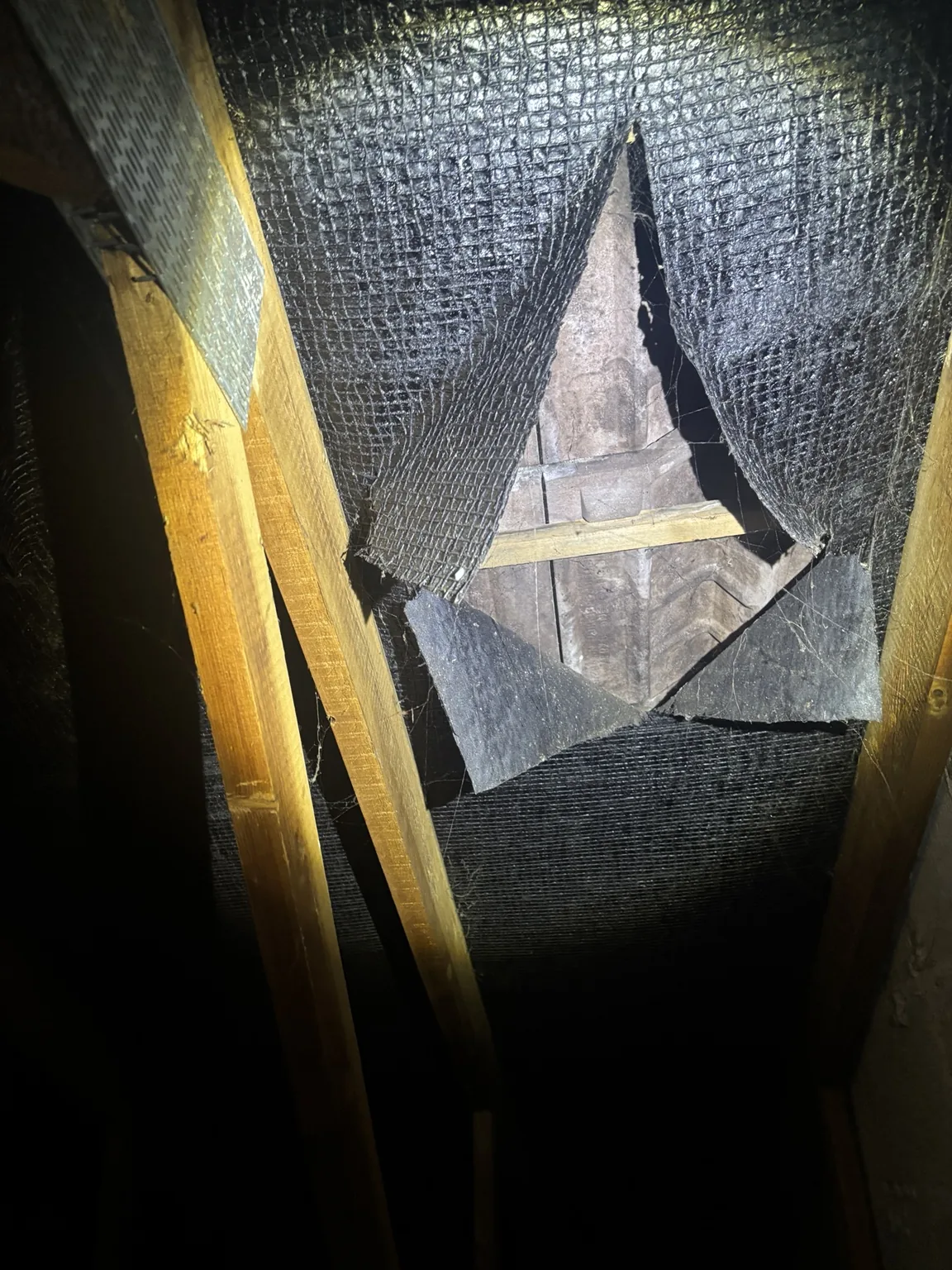
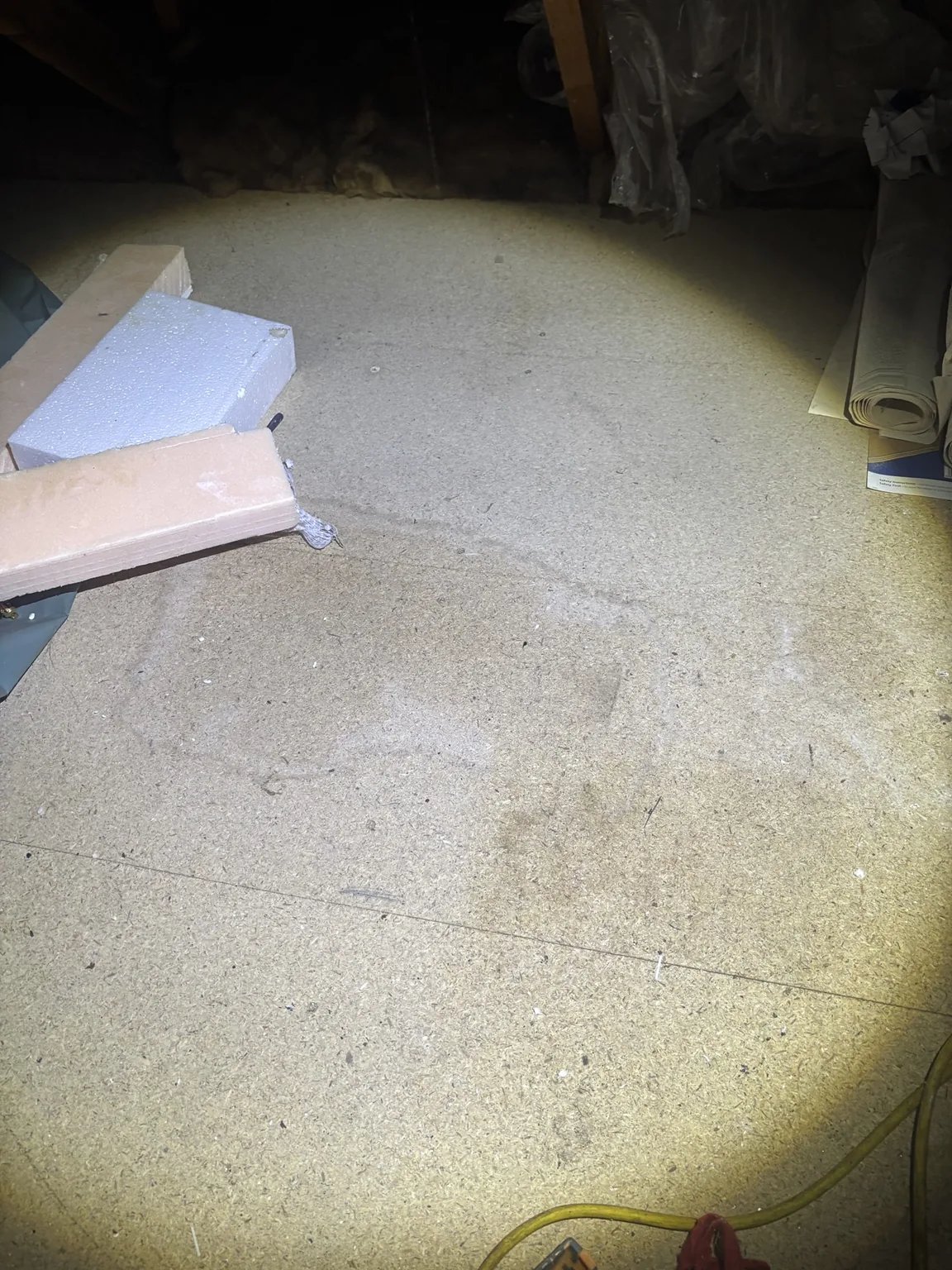
At this 1970s property, the secondary roof lining was torn over a localised area. Staining was also visible to the boarded loft area beneath the damaged section.
What is the secondary roof lining for?
The tiles or slates are the primary weathering layer, while the underlay provides secondary protection beneath them. It can help shed wind-driven rain or snow that passes the outer covering and provide a drainage path towards the eaves. It should not be regarded as a substitute for sound tiles, slates, flashings and junctions above.
Why is a tear significant?
A local tear interrupts that secondary protection. It does not necessarily mean that the roof is actively leaking, because the outer roof covering should still provide the primary weather resistance. However, any water that penetrates the tiles in this area has a more direct route into the roof space.
What does the staining tell us?
The staining to the boarding beneath the tear is consistent with previous moisture affecting the area, but it does not by itself prove that the tear was the source. The photographs cannot establish whether the staining resulted from an isolated historic event, wind-driven rain, a defect to the roof covering above, condensation or another moisture source. The roof covering and details immediately above the affected area should therefore be inspected carefully and the surrounding timbers checked for signs of ongoing dampness or deterioration.
How should it be repaired?
The repair method should be compatible with the existing underlay and follow the relevant manufacturer's or roofing-system guidance. Small tears may sometimes be suitable for a proprietary repair tape, while larger tears can require a properly lapped patch or local replacement of the underlay. In practice, lifting roof coverings may be necessary to achieve a robust repair and maintain the intended drainage path and laps. Any defective tiles, flashings or other weathering details above the affected area should be repaired at the same time.
Why the surrounding evidence matters
A torn membrane viewed in isolation may appear relatively localised. The staining beneath it makes the area more significant because it is consistent with previous moisture nearby, even though the precise source still needs to be established. Survey findings are strongest when the construction detail, the visible defect and the surrounding evidence are considered together.