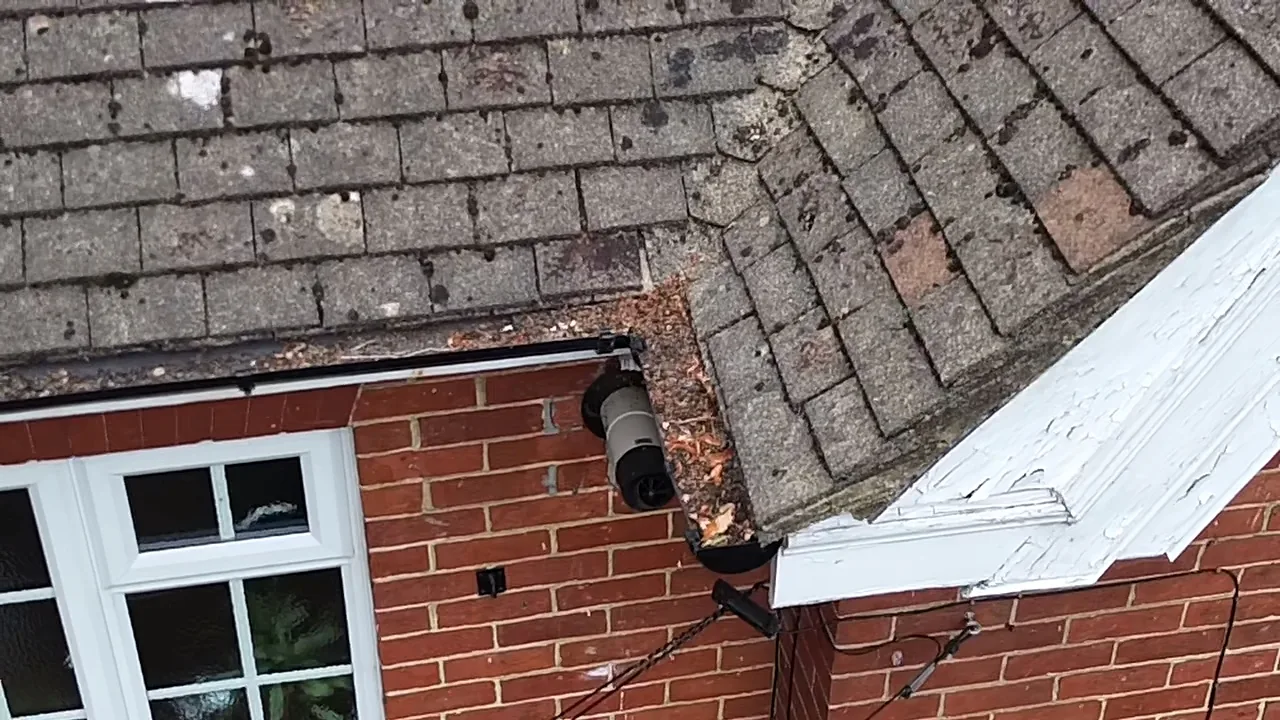
The owners of this 1908 semi-detached house in Havant reported dampness internally. A focused defect inspection identified heavily blocked rainwater goods at the relevant part of the building, together with deterioration to the adjoining timber fascia and soffit boards. Dampness was also present internally to the main walls adjacent to the affected rainwater goods.
Why blocked gutters can cause damp problems
Gutters are intended to collect roof water and discharge it safely into the drainage system. Where leaves, moss and other debris obstruct the flow, rainwater can back up or overflow. Repeated wetting of the wall below can saturate masonry and contribute to penetrating dampness internally, particularly in older solid-walled or more exposed construction.
What else was found?
The inspection also identified deteriorated timber fascia and soffit boards at the roof edge. Persistent moisture around overflowing or leaking rainwater goods can accelerate the breakdown of decorative finishes and lead to timber decay if the defect is allowed to continue.
Linking the external defect with the internal symptoms
Damp staining or elevated moisture readings inside a property should not automatically be labelled as rising damp. The position of the internal dampness needs to be considered alongside the external construction and any defects capable of introducing water. In this case, the proximity of the internal dampness to the blocked rainwater goods made the external rainwater defect an important likely contributor.
What should happen next?
The rainwater goods should be cleared and checked for correct alignment, sound joints and effective discharge. Defective sections should be repaired or replaced as required. The decayed fascia and soffit timbers should be assessed and repaired or renewed, followed by suitable preparation and redecoration. Once the source of excess moisture has been addressed, the internal walls should be allowed time to dry before the need for further remedial work is assessed.
Why a focused defect report can help
Moisture problems can have several possible causes. A focused defect inspection considers the reported symptom together with the surrounding roof, rainwater disposal, external walls, openings and internal finishes to identify the most likely source and recommend proportionate repairs rather than treating the symptom alone.
Read more about surveys and defect inspections in Havant.