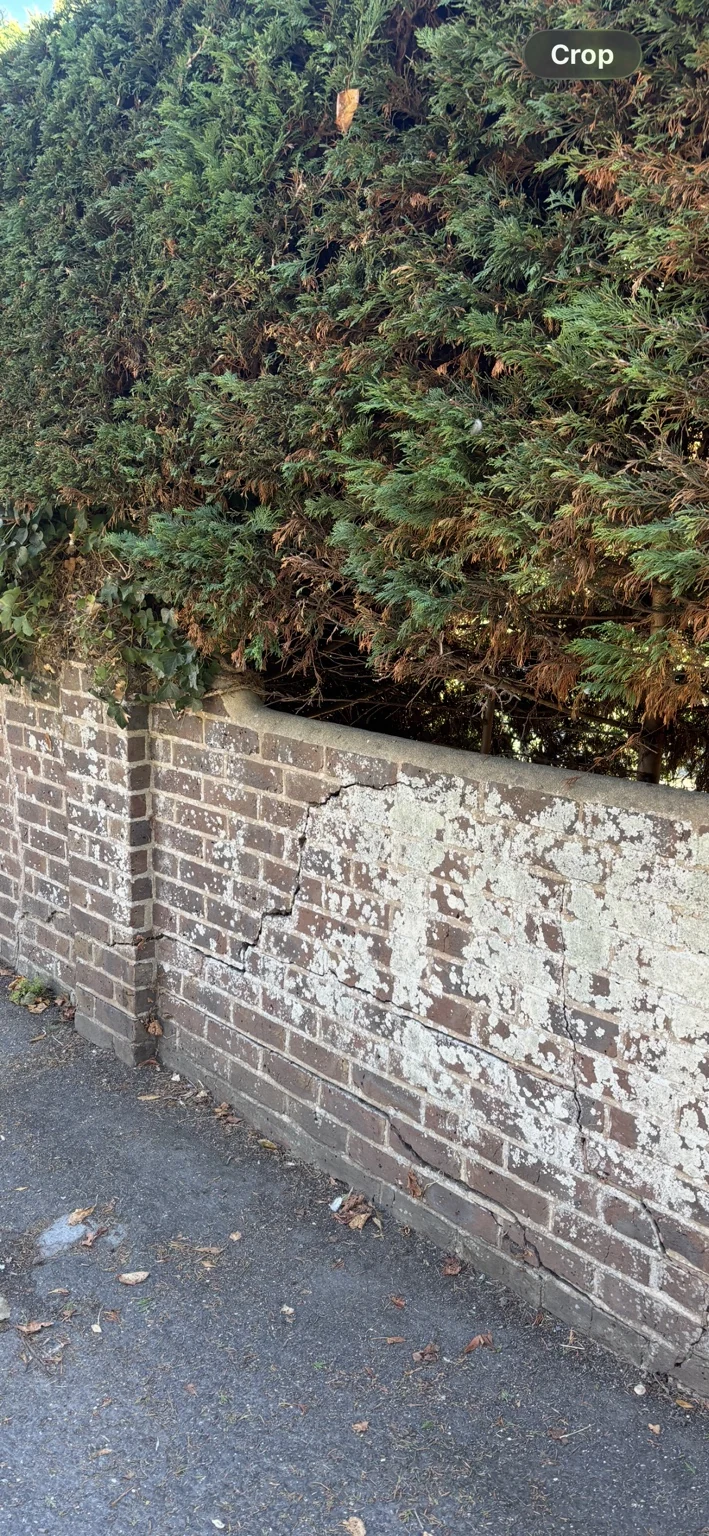
During this RICS Level 2 Home Survey in Worthing, significant stepped and vertical cracking was noted to the front boundary wall close to dense established vegetation.
Can roots cause this type of cracking?
They can be a contributing factor, but the cause should not be assumed from a photograph alone. Roots can exert local pressure on shallow walls and foundations, while trees and larger shrubs can also influence moisture conditions within some soils.
Other possible causes include inadequate foundations, historic movement, impact damage, weathering, poor previous repairs or a combination of factors.
Why are boundary walls vulnerable?
Garden and boundary walls are often lightly founded compared with the main building. They are exposed to weather on both sides and can be affected by changes in ground level, vegetation growth and localised movement. Once cracking develops, water can enter open joints and accelerate deterioration.
Does cracking mean the wall is unsafe?
Not necessarily. The significance depends on the width and pattern of cracking, whether the wall is leaning or bulging, its height and construction, and whether movement appears progressive. Loose masonry or an unstable section next to a pavement or access route can present a safety concern and should be dealt with promptly.
What should happen next?
The wall and nearby vegetation should be considered together. Where root influence is suspected, simply cutting back visible growth may not resolve the cause, and indiscriminate removal of substantial vegetation can sometimes alter ground conditions. The appropriate repair may range from localised rebuilding to more extensive reconstruction with improved foundations, depending on the extent of movement.
If there is uncertainty over the cause or stability, further assessment by an appropriately experienced contractor or engineer may be warranted before repair work is specified.
What a survey can reveal
Boundary structures are part of the property and can carry real repair and safety implications. Identifying cracking, leaning or vegetation-related movement before purchase allows a buyer to budget for repairs and establish whether further investigation is needed.