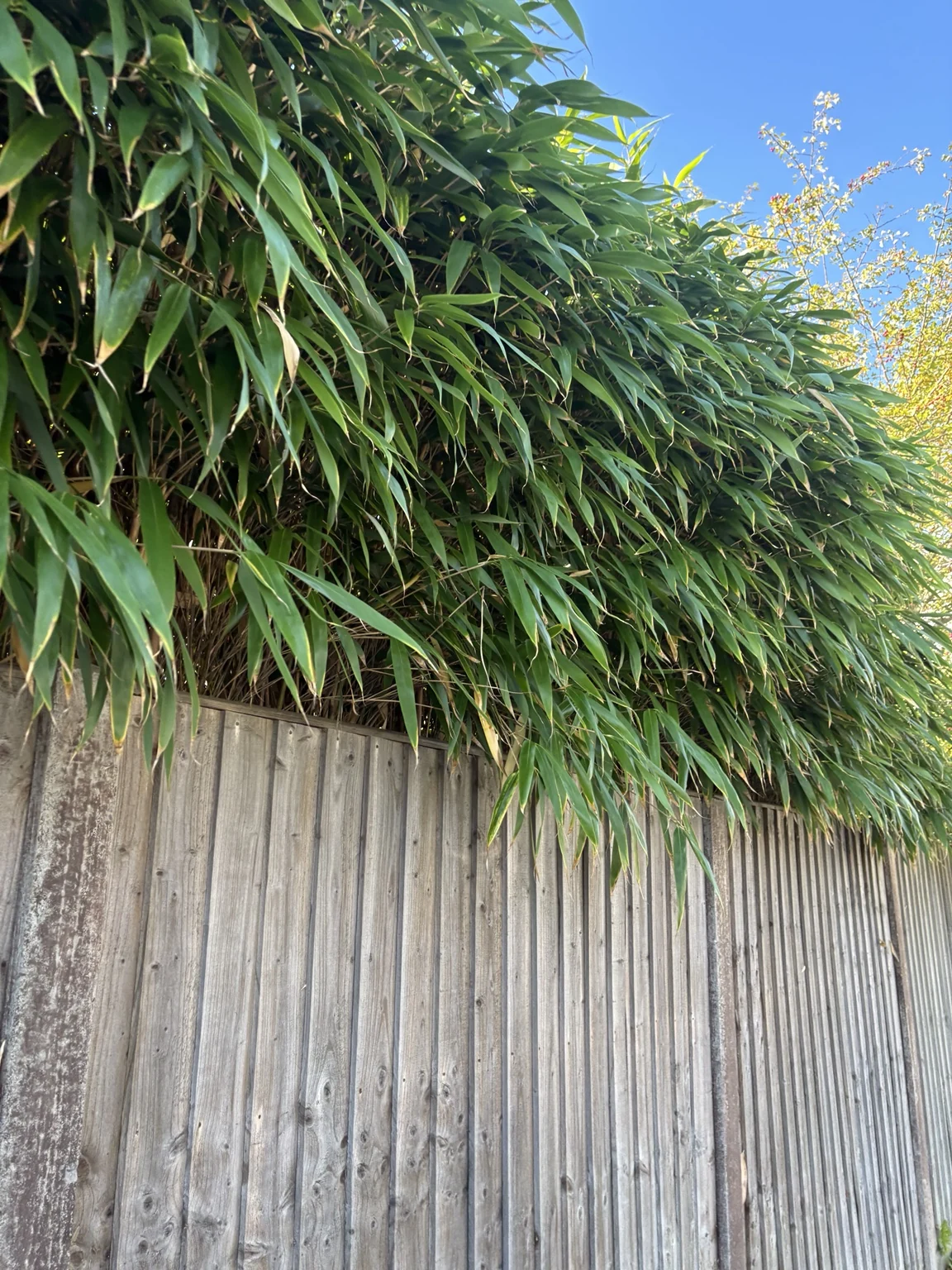
During this RICS Level 2 Home Survey in Worthing, dense bamboo growth was noted immediately beyond the boundary, with foliage extending over the fence line into the subject property.
Why can bamboo become difficult to control?
Bamboo varies considerably by species. Some types form relatively contained clumps, while others spread by underground rhizomes that can travel well beyond the visible plant. Once established, repeated cutting of the visible stems alone may not control the underground growth.
The full extent of rhizomes cannot normally be established during a visual home survey, particularly where they pass beneath soil, paving, fencing or adjoining land.
Can bamboo affect a property?
Uncontrolled growth can become a persistent maintenance issue. Rhizomes may spread into borders, lawns and gaps beneath lightweight landscaping, and can exploit weaknesses around paving or other external features. The significance depends on the species, distance from the building, containment measures and how long the planting has been established.
Bamboo should not automatically be assumed to be causing structural damage simply because it is present. The main concern is uncontrolled spread and the cost and difficulty of managing or removing it if it crosses the boundary.
What if the bamboo originates next door?
Where the source appears to be on adjoining land, control may require cooperation between neighbouring owners. Growth crossing the boundary can become a source of disagreement if responsibility for containment, access or removal is not clear.
A buyer should therefore consider the visible extent of the planting, ask whether any previous discussions or control work have taken place and understand that treatment confined to one side of the boundary may not always provide a lasting solution.
What should a buyer do?
If bamboo is extensive or close to buildings, hard landscaping or drainage, specialist horticultural advice may be appropriate before purchase. Where spread from adjoining land is apparent, the buyer's legal adviser may also wish to raise enquiries about any previous disputes, agreements or treatment.
What a survey can reveal
Grounds and boundary features can create future expense even when the house itself appears well maintained. Identifying aggressive or difficult-to-control planting before exchange gives a buyer the opportunity to understand the likely management implications and ask further questions.